AI Shopping SEO: How to Get Your Products Recommended by AI

Your buyer opens ChatGPT and types “best running shoes for flat feet.”
They get four products back. Not ten blue links. Four.
If you’re not one of the four, you didn’t lose a ranking. You never got in the room.
That shift is already paying out. AI-source traffic to U.S. retail sites grew 693% over the 2025 holiday season, and those shoppers convert at roughly 5x the rate of normal organic search.
Most advice treats this as one trick. Submit a feed. Add schema. Done.
It isn’t one trick. It’s two jobs that look alike and work nothing alike, and mixing them up is the reason most stores stay invisible.
Here’s the whole thing: what AI shopping SEO is, how each engine picks products, and the work that gets yours named.
This area moves fast, so the page is dated. Last updated September 2026.
Quick answer. AI shopping SEO gets your products listed, then recommended, inside AI shopping answers: ChatGPT shopping, Perplexity shopping, Google AI Mode, and Gemini. Listing comes from clean product feeds, and Shopify handles most of that for you. The recommendation comes from trust: complete metadata, fresh reviews, honest price and stock, and product pages a model can quote. You can’t buy the slot, so the data does the selling.
TL;DR
- AI shopping SEO = feed quality (gets you listed) + trust signals (gets you recommended).
- In-chat checkout retreated in 2026. Discovery won. Buyers research in AI, then buy on your site.
- ChatGPT ranks products on relevance and metadata. Organic, unsponsored, unbuyable.
- Perplexity runs a free merchant program. Google grounds its AI answers in the Shopping Graph.
- The scoreboard is share of voice: how often AI names you when buyers ask.
AI-source traffic to U.S. retail sites grew 693% over the 2025 holiday season (Adobe Analytics). Feed and catalog figures from OpenAI and Google documentation.
What is AI shopping SEO?
AI shopping SEO is the work of getting AI assistants to name your products when buyers ask what to buy.
Some people call it AI commerce SEO. Others call it GEO for ecommerce. Same job, different label.
The prize isn’t a ranking. It’s a recommendation.
Old SEO wins you a spot on a page the shopper still has to scan. AI shopping SEO wins you a spot inside the answer itself.
There’s no page two. A model names three or four products, and the rest of the market vanishes for that query.
Two things change because of that.
First, your product data does the heavy lifting. Feeds, schema, and variant-level facts are what the engines actually read.
Second, the scoreboard changes. Keyword rank tells you nothing here, so you track AI share of voice: how often AI names you against your rivals for the same buyer questions.
How does AI product discovery work?
Every engine runs the same funnel with different plumbing.
Product data flows in from feeds and crawls. The model matches products to the question. Then it picks the few it trusts enough to say out loud.
So you’re working two hand-offs: getting into the pool, and getting picked from it.
What feeds an AI product recommendation
your product
Feeds and schema get you into the pool. Reviews, citations, and clean data get you picked from it.
Getting into the pool is mechanical. You need a product feed or an AI-readable catalog, and that’s close to a checkbox.
Getting picked is a trust call the model makes on every single query.
It leans on the same short list of signals across engines: how complete your metadata is, how strong your reviews are, whether your price and stock are honest, and whether trusted third-party pages mention you. We pulled that picking logic apart in how AI chooses products to recommend.
One distinction saves you months of wasted work.
Being listed is not being recommended. A perfect feed makes you findable. It doesn’t make you the pick.
The ChatGPT shopping and Shopify AI catalog guide covers that gap in full.
What happened to AI checkout, and why it’s good news
The 2025 story was agents buying things for you.
OpenAI shipped Instant Checkout in ChatGPT with Stripe in September 2025. Google followed with agentic checkout built on the Universal Commerce Protocol it co-developed with Shopify.
Then reality voted.
The AI checkout arc, in three beats
Sept 2025
Checkout launches
Instant Checkout goes live in ChatGPT with Etsy sellers and a promised million-plus Shopify merchants.
Mar 2026
Checkout retreats
OpenAI pulls Instant Checkout after roughly 30 Shopify merchants go live. Buyers preferred finishing the purchase on the store's own site.
Now
Discovery wins
ChatGPT doubles down on product discovery and merchant apps. The pattern that stuck: research in AI, buy on your site.
In-chat buying stalled. AI-driven discovery kept compounding. The visibility work is the part that pays.
That’s good news for you.
The scary version of AI commerce never landed. An agent buys through a black box, and you never meet the customer.
The version that stuck sends you a visitor who already trusts the pick. Which is why AI-referred shoppers convert at 14.2% against 2.8% for normal organic traffic.
Discovery is where the money is. Discovery is exactly what this work moves.
Track what those visitors do next with AI revenue attribution.
ChatGPT shopping SEO: how ChatGPT picks products
ChatGPT shopping shows product cards with an image, a price, reviews, and a link to you. They’re built from product feeds plus web data.
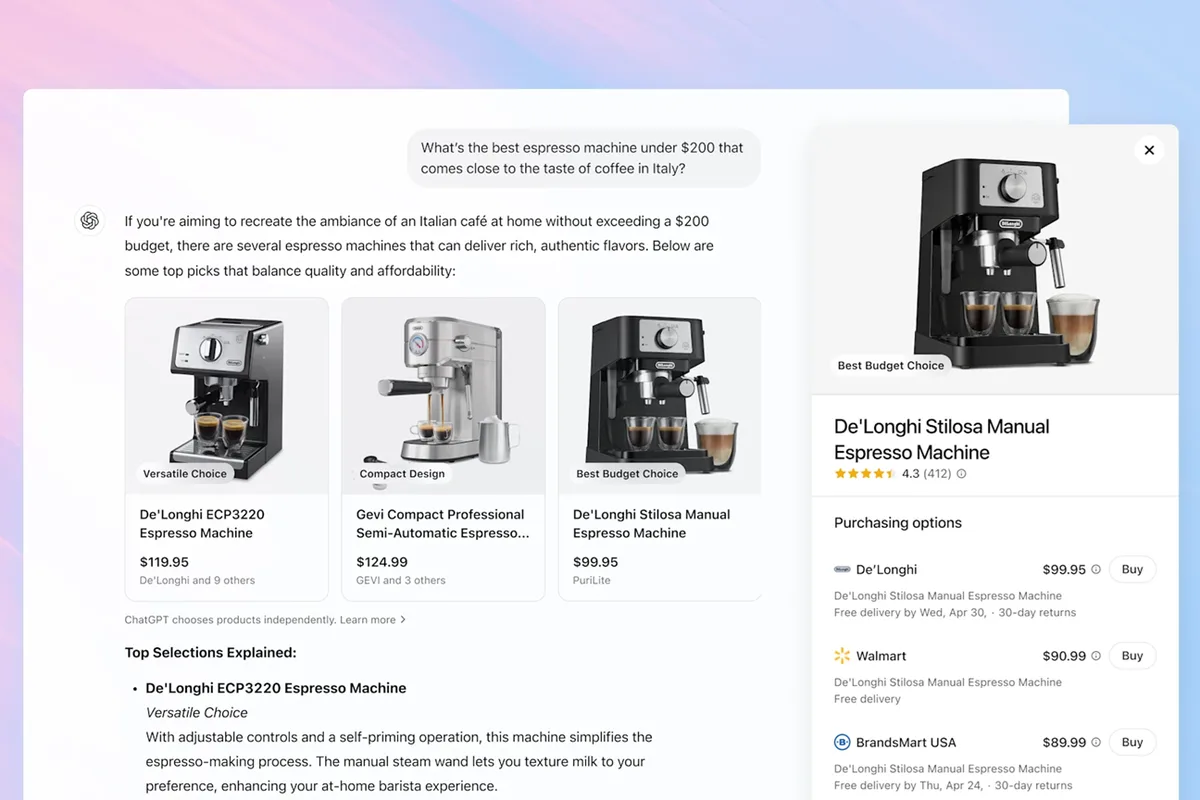
OpenAI is blunt about the ranking. Results are organic and unsponsored, ranked on relevance to the shopper.
Nobody can buy the slot you want. You can only earn it.
What ChatGPT weighs when it picks a product
The model matches the buyer's question against hard facts, then breaks ties on trust.
- Complete metadata. Title, description, price, stock, and attributes at variant level. Thin data loses matches it should win.
- Reviews. Volume, recency, rating, and what the reviews actually say. Review text gets read, not just counted.
- Price and stock accuracy. Stale prices and sold-out listings get skipped. Feeds can refresh every 15 minutes for a reason.
- Seller status. Makers and primary sellers get preference over resellers.
- Shopper context. Memory and custom instructions shape the pick. It's one reason two people see two different lineups.
Now the practical part.
You’re on Shopify, and Shopify already pushes your product data into AI shopping surfaces. That part is handled.
OpenAI’s own feed spec, JSONL pushed to their endpoint and refreshed as often as every 15 minutes, is invite-based for enterprise retailers. A normal store doesn’t submit it.
So ChatGPT product SEO is feed quality work, not feed plumbing work. Fill every field Shopify sends, keep stock honest, and make your product descriptions quotable.
Here’s the half most stores miss.
When ChatGPT answers “best natural deodorant for sensitive skin” in prose, it isn’t reading your feed at all. It’s citing buying guides, reviews, and press, and Amazon alone takes roughly a fifth of its commerce citations.
Getting named in that layer is citation work. It feeds back into the shopping layer too, because a model trusts products it keeps meeting in sources it already trusts.
Perplexity, Google AI Mode, and Gemini product visibility
Three engines, three front doors. The work overlaps a lot, but the doors are worth knowing.
How you get in, engine by engine
ChatGPT
Product feed via your platform. Shopify syncs it. Direct feed submission is enterprise, invite-based.
Ranked on relevance, organic. No paid placement
Perplexity
Free Merchant Program: connect your feed, get shopping visibility, analytics, and one-click Buy with Pro.
Costs $0, zero commission on sales
Google + Gemini
One pipe: Merchant Center → Shopping Graph grounds AI Mode, AI Overviews, and Gemini shopping answers.
Feed disapprovals = invisible to all three
Three front doors, one theme: clean product data in, recommendations out.
Perplexity runs a Merchant Program. It’s free, takes no commission, puts your inventory into Perplexity’s shopping results, and hands you a performance dashboard.
Perplexity also links out in most of its answers. So a listed product and a cited buying guide can both point at you, which is a rare double.
Google is the biggest pipe, because it already exists.
The Shopping Graph holds 50+ billion listings and refreshes hundreds of millions of times an hour. It grounds product answers in AI Mode, AI Overviews, and the Gemini app.
Your Merchant Center feed is the input. Which means one disapproval quietly wipes you off all three Google surfaces at once.
Google started piloting AI performance reporting inside Merchant Center in July 2026. It’s the first engine handing merchants native visibility numbers.
Gemini product visibility isn’t a separate project. It’s Merchant Center hygiene with higher stakes.
Google’s Universal Commerce Protocol, built with Shopify, is rolling agentic checkout out with Nike, Sephora, and Walmart. Watch it. Don’t wait for it, because discovery is the layer paying today.
AI product feeds: the new sitemap
Ten years ago the technical baseline was a sitemap and clean HTML.
Today it’s the product feed plus schema.
The feed tells the engine what’s true. Schema proves it on the page. Reviews make it believable.
You almost certainly don't need to build a feed by hand. Shopify generates and syncs AI-readable product data for you, and Merchant Center handles Google. The failure mode isn't a missing feed. It's a synced feed full of thin titles, missing GTINs, wrong stock counts, and empty review fields.
What to fix, in the order it pays:
- Identifiers. GTIN or barcode, brand, and product type on every product. Matching engines lean on these hard.
- Variant-level truth. Price, stock, and options accurate per variant, not just per product.
- Titles and descriptions. Write for a model reading facts, not a shopper skimming. Front-load what it is, who it’s for, and what makes it different.
- Images. Real resolution, product only, current season.
- Schema on the page. Product, Offer, AggregateRating, and FAQ markup that agrees with the feed. A mismatch reads as dishonest. The Shopify schema guide walks through it.
- Reviews flowing. A review app that emits schema and keeps fresh reviews landing. Recency is a ranking signal, not a vanity metric.
The AI shopping SEO playbook: seven steps
The whole method, condensed. Steps 1 to 3 get you listed. Steps 4 to 6 get you recommended. Step 7 tells you if any of it worked.
- Unblock the crawlers. Check that OAI-SearchBot, PerplexityBot, and Google-Extended aren’t blocked in robots.txt. If AI can’t read you, nothing else matters. It’s the first thing we check in why stores aren’t cited.
- Clean the catalog. Run the feed checklist above on your top 20 products first, then work the long tail.
- Join the free programs. Perplexity’s Merchant Program, plus a healthy Merchant Center account. Both cost nothing and both gate real surfaces.
- Make product pages quotable. Answer-first descriptions, a real FAQ, and specifics a model can lift word for word.
- Stack reviews. Volume, recency, and detail. Review content gets read, not just the star average.
- Earn third-party mentions. Get into the buying guides and listicles models cite. That’s the trust layer no feed can buy. Start with listicles that get cited.
- Measure share of voice, then iterate. Find the queries where rivals get named and you don’t, close the gap, check again. Competitor citation tracking shows the method.
AI visibility for Shopify: how do you know it’s working?
You can’t fix what you can’t see. And AI shopping is genuinely hard to see.
Answers shift by user, by day, and by engine. Only about 30% of brands stay visible across back-to-back runs of the same question.
So a one-off manual check tells you almost nothing.
That’s the problem we built Shop Mentions to solve.
It runs your real buyer questions across ChatGPT, Perplexity, Gemini, and Google’s AI surfaces on a schedule. Then it tracks who gets named, cited, and recommended, including what ChatGPT’s shopping-enabled answers actually return rather than a sanitized API stand-in.
You get your AI share of voice, the sources behind every answer, and the trend line that tells you whether the playbook above is working.
The takeaway
Two jobs. Feed quality gets your products listed. Trust signals get them recommended.
The checkout land grab fizzled, and that’s fine. Discovery is the layer that pays, and it sends the highest-converting traffic in ecommerce.
Every front door is free. ChatGPT through your Shopify catalog, Perplexity through its Merchant Program, Google and Gemini through Merchant Center.
Which means the competition is pure data quality and trust. Nobody can outspend you here.
Start with the seven steps and your top 20 products. Then measure: run your buyer questions through the engines, see who gets named, and close the gaps one query at a time.
The stores doing this now are taking shelf space their rivals will have to buy back later.